

Philippines services
Knowing how to fill out sales invoices and official receipts are essential to keep all business transactions properly accounted for. Learn how to do it here!
Last updated on February 4, 2026
In the past, you might have noticed that Philippine establishments displayed a notice saying “Ask for Receipt” until the BIR issued RMO 43-2022, which updated it to “Notice to Issue Receipt/Invoice.” Meanwhile, when running a business, chances are a vendor has told you, “I’ll send you your invoice after you’ve settled your payment,” one way or another.
This reflected the old practice where businesses issued sales invoices for products and official receipts for services. Today, all sales — whether for products, services, or both — require an invoice, which serves as the primary document for recording transactions and complying with BIR regulations.
Failing to issue an invoice can result in penalties and fines. To avoid this, you and your staff need to know how to fill out an invoice correctly. Doing so also ensures your bookkeeping records are maintained properly.
With the implementation of the Ease of Paying Taxes (EOPT) Act and updated BIR regulations (RR 7-2024, RR 11-2024, and RMC 77-2024), the distinction between sales invoices and official receipts has been removed. Today, invoices are the primary document for recording all sales transactions, while official receipts are considered supplementary, mainly serving as proof of payment. We cover this transition in full detail in our post on what happened to official receipts in the Philippines.
Businesses that still have unused official receipts can convert them into invoices by labeling them appropriately and including all the required details. This ensures compliance with current BIR rules while maintaining accurate bookkeeping and proof of payment for customers.
An invoice is issued to customers who purchase your products or services. For VAT-registered sellers, a VAT invoice must be issued for every sale transaction, regardless of the amount. For non-VAT registered sellers, an invoice is required for transactions valued at ₱500 or more, or when the buyer requests a copy regardless of the amount.
Although the Tax Code only mandates invoices for transactions meeting the mentioned prices, companies can issue invoices for all sales activity to ensure consistent processes across all transactions.
Below is a step-by-step guide on how to fill out an invoice:
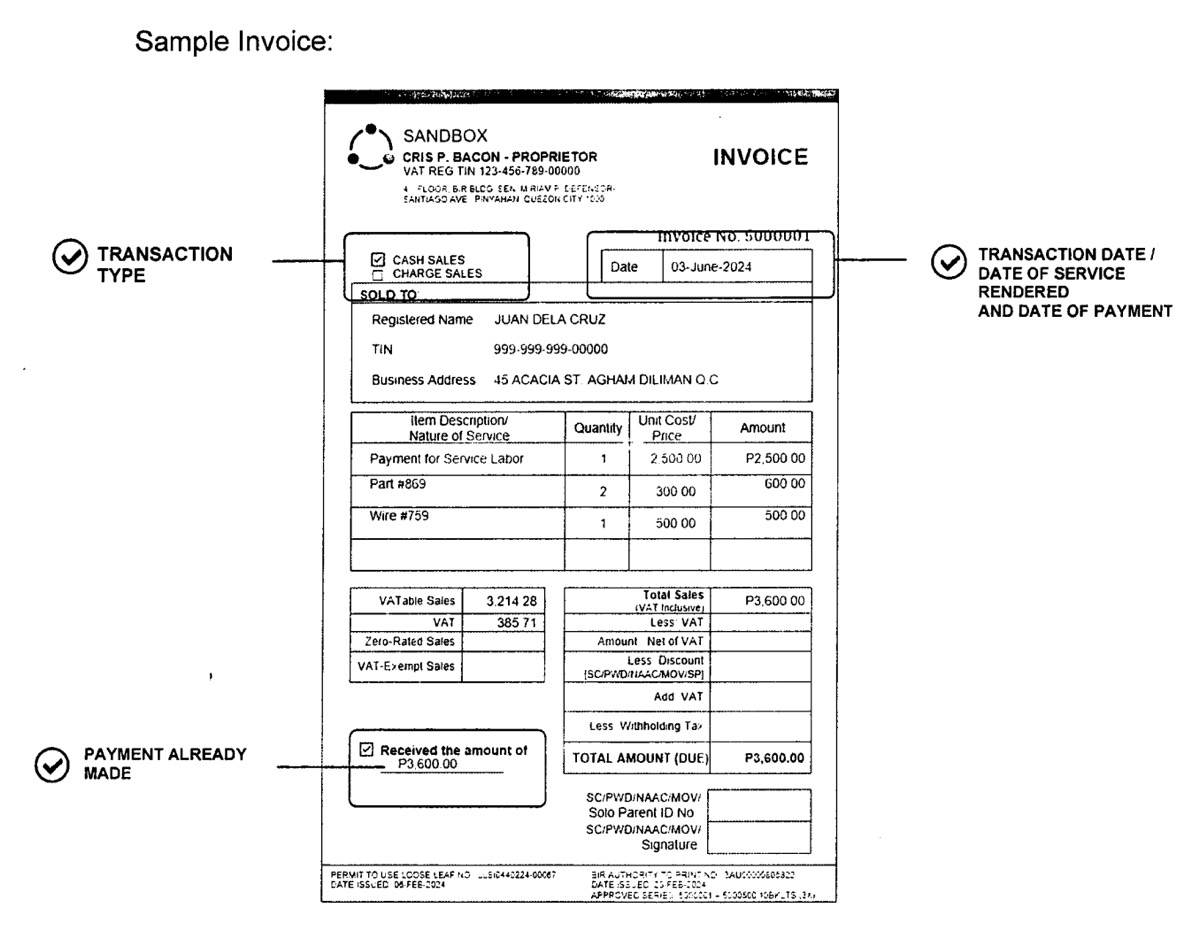
Source: RMC 77-2024
You’ll need the following information:
Note: If the sale of goods or services are directly between a business and consumers (B2C) who are the end-users of its products or services, the business address and TIN of the buyer are not required to be included.
An invoice number helps track transactions for bookkeeping and better organization of documents.
How you generate your invoice numbers is up to you, but a good way to start is to use letter shortcuts for the item, followed by the transaction date, and then the number it comes in a sequence.
For instance, if you sold red lipstick on September 9, 2022, and this was the fifth red lipstick you have ever sold, your invoice number can be RL1092022-05.
In the invoice, enumerate the products sold. You can lay them out using the following details:
A breakdown of all amounts involved is essential if there are mixed transactions. It includes VATable sales, zero-rated sales, VAT-exempt sales, and 12% VAT.
Remember that for non-VAT invoices, you should print “THIS DOCUMENT IS NOT VALID FOR CLAIM OF INPUT TAX” in bold letters at the face of the invoice. For transactions under VAT-exempted, it’s a must to have the word “EXEMPT” clearly indicated on the document.
Once you’ve verified that all details are filled out correctly, ask the client to sign the invoice.
Every invoice must have complete details to make bookkeeping smooth. It prevents confusion from clients, penalties from BIR, and irregularities when accounting for all your transactions.
If you’re interested in expanding your financial team to handle the work that comes with bookkeeping services, including keeping your invoices organized, consider outsourcing experts from CloudCFO, a cloud accounting firm for startups and small businesses in the Philippines that can assist with your accounting, bookkeeping, taxes, and other finance functions.
Get in touch with us for more information on how we can help you become confident in your finances so you stay focused on growing your business today!
Get clean, up-to-date books every month from a dedicated bookkeeping team working in Xero or QuickBooks.
Explore this service →or book a free consultation

Questions about how this affects your business? Our team replies within one business day.




























































