Philippines services
Improve your inventory management efficiency through purchase orders. Read this article to know what a purchase order is and how it can help your operations.
Last updated on July 22, 2026
You order 200 units from a supplier over a phone call or a Viber message. Three weeks later, 160 units show up, the price has quietly gone up 8%, and there’s nothing in writing to hold anyone to the original terms. This is the moment most SME owners first ask what a purchase order actually is — usually after a dispute, not before one.
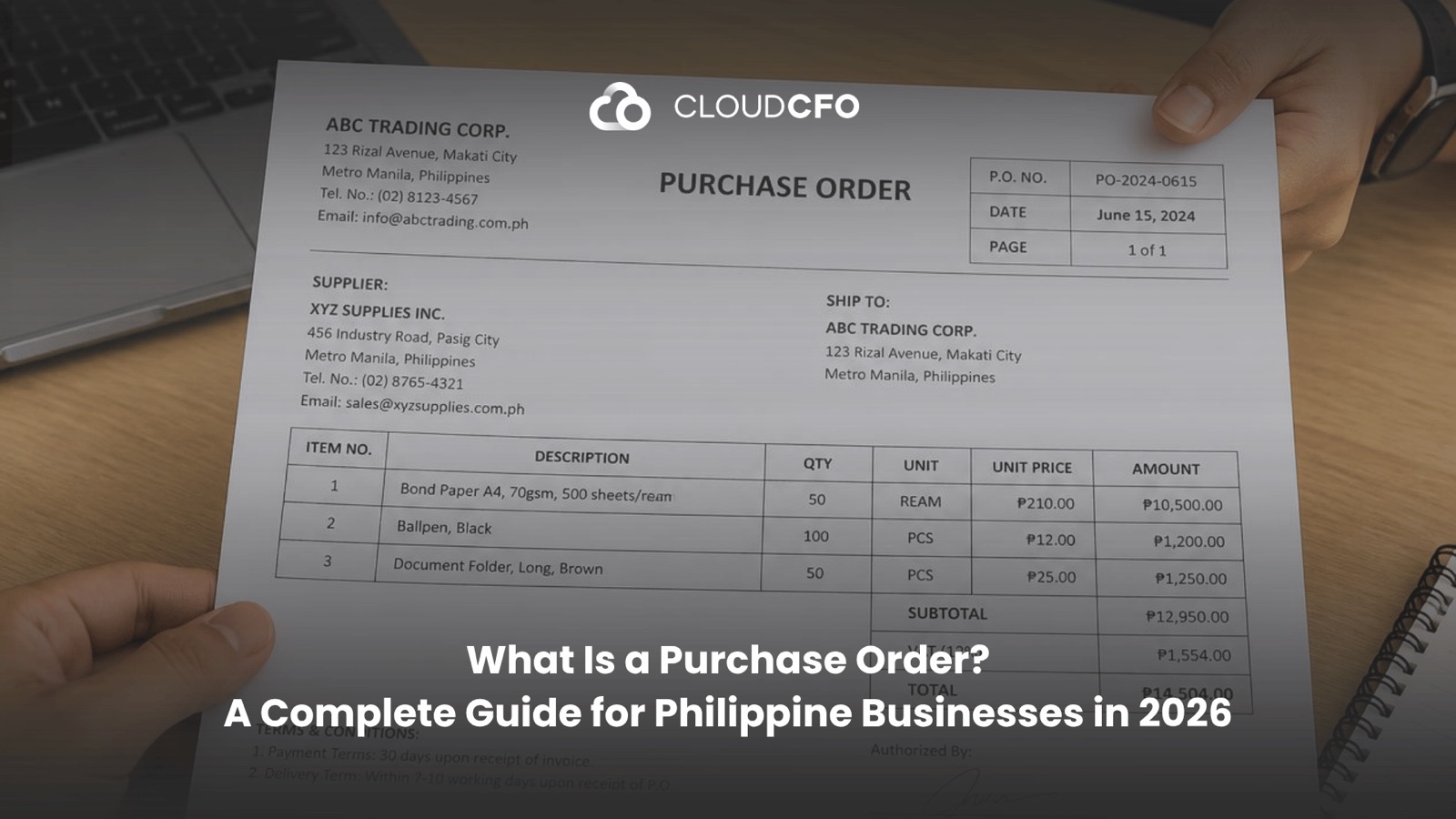
A purchase order (PO) is the document that would have prevented that argument. It’s a legally binding record of exactly what you ordered, at what price, and under what terms — issued by you, the buyer, before the supplier delivers anything. For businesses still running procurement through email threads and group chats, formalizing this one document is one of the highest-leverage, lowest-effort process fixes available.
A purchase order is a buyer-issued document that specifies the goods or services being ordered, the agreed quantity and price, and the delivery and payment terms — submitted to the supplier before delivery, as a confirmation of the order. This is the key distinction from an invoice: a supplier issues an invoice to request payment after delivering goods or services; a buyer issues a PO to confirm the order before that delivery happens.
Once a supplier accepts a PO — whether by countersigning it, fulfilling the order, or issuing a corresponding sales confirmation — it becomes a binding contract. If a supplier ships fewer units than the PO specifies, or delivers defective goods where the PO grants the right to reject them, the PO is what a business points to.
This is where most treatments of this topic stop short, and it’s the part that matters most for a Philippine business. Under Section 232 of the National Internal Revenue Code, every taxpayer must keep books of accounts that record all transactions completely, accurately, and systematically.
Purchase orders themselves aren’t the BIR’s primary evidence for a transaction — that role belongs to the sales invoice or official receipt issued by the supplier. But Revenue Memorandum Circular No. 2-2014 is explicit that purchase orders, delivery receipts, order slips, and similar documents are commercial receipts that form part of a taxpayer’s accounting records, serving as supplementary — not primary — evidence alongside the invoice or receipt.
In practice, this means an auditor reconstructing a transaction will typically want to see the PO, the delivery receipt, and the supplier’s invoice line up — same quantity, same price, same dates. A missing or inconsistent PO doesn’t invalidate your input tax claim on its own, but as supplementary evidence, it’s part of what an examiner uses to corroborate the primary documents — and gaps here are the kind of thing that can slow a review down. (For goods-based businesses specifically, maintaining a purchase journal alongside the general journal and ledger is standard BIR practice — confirm the specific requirement for your business classification with your tax adviser, since this can vary by registration type.)
A few mistakes show up repeatedly — especially among F&B and retail businesses running multiple branches, and tech startups formalizing vendor relationships for the first time.
“We’re too small to need this.” Most businesses assume POs are for large enterprises with dedicated procurement teams. That’s backwards — the businesses most exposed to supplier disputes are the ones without the leverage or legal budget to fight them. A one-page PO template costs nothing and settles the argument before it starts.
“Our accounting software will catch it if something’s wrong.” Cloud accounting tools like Xero and QuickBooks can generate and track purchase orders, but the software only reconciles what you enter into it. If procurement still happens over chat — and the PO gets created after the fact or not at all — the tool has nothing to match against.
“A PO and an invoice are basically the same thing.” They’re not, and conflating them causes real confusion at reconciliation. The PO is your order, issued before delivery. The invoice is the supplier’s bill, issued after. A business that treats them interchangeably usually discovers the gap only when a BIR audit asks for supporting documents that were never created.
| Element | What It Covers |
|---|---|
| Company information | Buyer’s name, logo, address, contact details, and requesting department |
| PO number | Sequential reference number for tracking through the order lifecycle |
| Date | Date of issuance, plus delivery and expiry dates under terms and conditions |
| Vendor information | Supplier’s name, address, and contact person |
| Item description | Specific product, with model or reference number where applicable |
| Quantity | Units being ordered |
| Unit price | Cost per unit |
| Total price | Sum of the order |
| Payment terms | Payment mode, due date, and whether payment is before or after delivery |
| Shipping information | Delivery mode and any associated fees |
Tech-enabled startups and early-stage SMEs. Procurement is usually software subscriptions, equipment, or small-batch inventory. The risk here isn’t supplier disputes — it’s losing track of recurring commitments as headcount grows. A simple PO log, even in a shared spreadsheet or your Xero/QuickBooks PO module, closes that gap before it becomes a bookkeeping headache.
F&B, retail, and logistics businesses scaling past Php 10M in revenue. This is where PO discipline earns back the most. Multiple branches ordering independently, perishable inventory, and thin margins mean a short-shipped or overpriced delivery hits the bottom line immediately.
Subsidiaries of international groups. The parent company likely already has a global procurement policy and PO format. The gap is usually local: PH suppliers expect the PO to reflect local terms — VAT treatment, peso pricing, and delivery timelines specific to the Philippine operation.
The Philippines is moving toward mandatory structured e-invoicing. Under RR No. 11-2025, large taxpayers, e-commerce businesses, and businesses using invoicing software must issue structured invoices through the BIR’s Electronic Invoicing System, with the compliance deadline for the first group of covered taxpayers moved to December 31, 2026 under RR No. 26-2025.
This shift is about invoices, not purchase orders directly. But businesses whose PO data is already digitized and consistent will find reconciling against structured, system-generated invoices far less painful than those still tracking POs in scattered spreadsheets.
A purchase order isn’t the document that satisfies a BIR audit on its own — but it’s the document that makes every other part of the audit faster.
CloudCFO works with SMEs across F&B, retail, logistics, and tech to build procurement and bookkeeping processes that hold up under a BIR audit, and we integrate purchase order tracking directly into the Xero or QuickBooks setups we manage for clients through the CloudCFO Web App.
If you want a second opinion on whether your current procurement paper trail would hold up, book a free consultation with us today. Book a Free Consultation
Get clean, up-to-date books every month from a dedicated bookkeeping team working in Xero or QuickBooks.
Explore this service →or book a free consultation

Questions about how this affects your business? Our team replies within one business day.